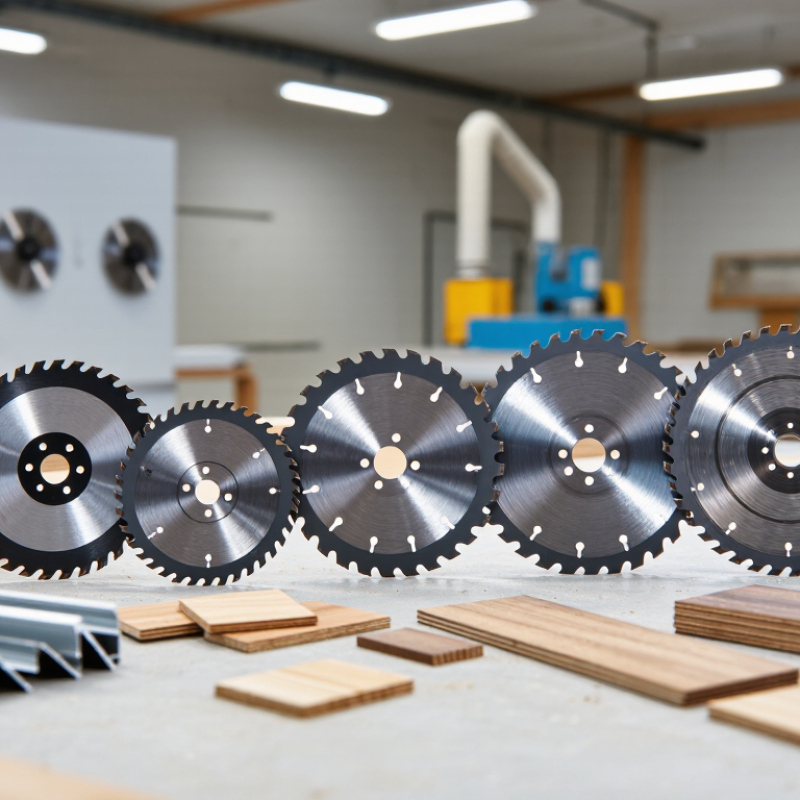
Choosing the right Carbide Saw Blades can change a clean production run into an expensive maintenance problem. In real workshops, the blade often reveals its quality through small details. A sharp edge leaves smooth kerfs, controlled dust, and fewer burnt marks. A poor match may vibrate, wander, or lose teeth after only a few cuts.
The best choice depends on the material, machine, tooth design, and cutting conditions. Solid hardwood usually requires a different tooth geometry than plywood, laminate, aluminum, or composite panels. Tooth count also matters. More teeth can produce a finer finish, while fewer teeth may clear chips faster during rough cutting. Kerf width, hook angle, blade diameter, arbor size, and maximum speed deserve careful attention.
No universal blade exists. Even experienced operators sometimes focus too heavily on tooth count and overlook feed rate or machine alignment. That mistake can make a high-quality blade appear ineffective. This guide explains how to compare Carbide Saw Blades using practical criteria, manufacturer specifications, and observable cutting results. It also considers carbide grade, tooth brazing, expansion slots, and expected service life. Reliable manufacturers publish clear performance data and safety limits, but real-world testing remains valuable. Record the material, blade model, cut quality, and operating speed. Those simple notes can expose patterns over time. A careful selection process saves material, reduces downtime, and supports safer, more consistent work.
A carbide saw blade combines a rigid steel body with carbide teeth fixed to its rim. The steel body provides stability, while carbide resists wear during repeated cutting. Each tooth removes a small chip as the blade rotates. Tooth geometry controls that action. Rake angle affects how aggressively the tooth enters the material. Gullet size carries chips away from the cut. Expansion slots help reduce heat and vibration, especially during long cuts.
Your material should guide the blade choice. Fewer teeth usually create faster cuts in thick wood, while more teeth produce smoother edges in thin panels. Plastic and non-ferrous metals need suitable tooth angles and clearance. A narrow kerf can reduce material waste, but it may demand better alignment.
I have found that even a premium blade performs poorly when the arbor is dirty or the workpiece moves. That detail is easy to overlook.
Tips: Check the blade diameter, bore, tooth count, and rotation direction before installation. Keep the blade sharp and clean. Use steady pressure, not force. Listen for sudden vibration or a harsh cutting sound. These signs may indicate heat buildup, incorrect setup, or a damaged tooth. Blade selection is not perfectly predictable. Test cuts on scrap material can reveal problems before they reach the finished piece.
How to Choose the Best Carbide Saw Blades?
Choosing a carbide saw blade starts with the material, not the machine. Wood, aluminum, plastic, and laminated boards create different cutting demands. For clean crosscuts in hardwood, choose a blade with more teeth and a finer grind. Fewer teeth usually remove chips faster during ripping. Cutting aluminum requires a blade designed for non-ferrous metals, with suitable tooth geometry and clearance. Using a wood blade on metal can damage the teeth and create unsafe heat.
Tips: Match the blade diameter and arbor size to your saw. Check the manufacturer’s speed range before cutting. A negative rake angle can improve control on some metal applications. For plastics, moderate tooth spacing helps reduce melting and rough edges. Keep the blade clean; resin and dust can change its performance.
Application details matter. A thin kerf blade wastes less material and needs less power, but it may deflect under heavy pressure. A thicker blade often gives straighter cuts on dense stock. I have seen operators choose a high tooth count for speed, then struggle with slow feeding and burning. That choice looked logical, but it ignored chip clearance. Test a small offcut first. Material thickness, feed rate, and machine stability can change the result. No selection chart replaces observation. Even experienced users occasionally choose the wrong blade.
| Material or Workpiece | Recommended Carbide Blade Type | Tooth Geometry | Typical Tooth Count | Rake Angle Guidance | Best Cutting Application | Expected Cutting Result | Important Selection Notes |
|---|---|---|---|---|---|---|---|
| Softwood and hardwood, rip cutting | General-purpose or ripping carbide-tipped circular saw blade | Flat-top grind (FTG) or combination tooth design | 24–32 teeth for a 250–305 mm blade | Positive rake, commonly about 10°–20° | Fast cuts along the grain in solid timber and dimensional lumber | Fast material removal with good chip clearance | Use fewer teeth for speed and thicker stock; ensure the blade is rated for the saw’s diameter and RPM. |
| Softwood and hardwood, crosscutting | Fine-finish carbide crosscut blade | Alternate top bevel (ATB) | 40–80 teeth for a 250–305 mm blade | Moderate positive rake, commonly about 5°–15° | Clean cuts across the grain, trim work, and joinery preparation | Smooth edges with reduced breakout | More teeth generally improve finish quality but reduce feed speed and chip clearance. |
| Plywood, OSB, and veneer panels | Fine-finish panel blade | ATB or high-ATB for improved surface quality | 60–100 teeth for a 250–305 mm blade | Low to moderate positive rake | Crosscutting sheet goods and veneered panels | Clean face cuts with less splintering | Support the panel properly and keep the blade sharp; excessive tooth count may increase heat and loading. |
| MDF, particleboard, and laminated board | Durable panel-processing blade | Triple-chip grind (TCG), often with a robust carbide grade | 60–96 teeth for a 250–305 mm blade | Low positive or neutral rake | Repeated cutting of abrasive engineered wood panels | Stable cuts and improved edge life under abrasive conditions | Dust extraction is important; abrasive dust can dull teeth quickly and increase heat. |
| Melamine, laminates, and coated panels | Laminate and coated-panel blade | TCG or high-ATB with a polished cutting edge | 60–96 teeth for a 250–305 mm blade | Low positive or neutral rake | Cabinet components, furniture panels, and decorative laminates | Reduced chipping on the decorative surface | For production work, a scoring blade or a suitable scoring setup may further reduce bottom-surface breakout. |
| Non-ferrous metals such as aluminum and brass | Non-ferrous-metal carbide blade | Triple-chip grind or modified TCG with a large gullet | 60–100 teeth for a 250–305 mm blade | Negative rake, commonly about −5° to −10° | Cutting extrusions, thin sheet, tubing, and profiles | Controlled cutting with reduced grabbing and burr formation | Use lubrication or mist where permitted, clamp the work securely, and never exceed the blade’s rated speed. |
| Rigid plastics and PVC | Plastic-cutting carbide blade | TCG or fine ATB with generous gullets | 60–100 teeth for a 250–305 mm blade | Low positive or negative rake | Cutting PVC sheets, acrylic panels, and rigid plastic profiles | Cleaner edges with less melting and chipping | Use a steady feed rate and adequate chip clearance; excessive friction can melt thermoplastics. |
| Thin stock and small workpieces | Thin-kerf carbide blade | ATB or combination tooth design | High tooth count relative to blade diameter | Low to moderate positive rake | Portable saws, trim saws, and low-power equipment | Lower material waste and reduced motor load | Verify that the saw is approved for thin-kerf blades and that the blade does not deflect during cutting. |
| Thick solid wood and heavy stock | Heavy-duty carbide ripping blade | FTG or low-tooth-count combination design with deep gullets | 18–32 teeth for a 250–305 mm blade | Positive rake, commonly about 10°–20° | High-volume ripping and dimensioning operations | Fast feed rates and efficient chip evacuation | A lower tooth count is usually preferable, but the finish may require a secondary crosscut or finishing operation. |
| Mild steel and thin-wall steel tubing | Specialized carbide-tipped cold-cutting metal blade | TCG or specially designed metal-cutting tooth form | Selected according to wall thickness and outside diameter | Negative rake, commonly about −5° to −10° | Cold saws and approved metal-cutting machines | Cooler, more controlled cuts than abrasive wheels when correctly applied | Use only a blade specifically rated for the metal, machine, speed, feed, and coolant conditions; ordinary woodworking blades are unsuitable. |

Choosing the best carbide saw blade starts with matching tooth count to the material and cut quality you need. A blade with fewer teeth cuts faster and clears chips efficiently in thick timber. However, it may leave a rougher edge. More teeth usually produce smoother cuts in plywood, plastic, and thin boards, but they require a slower feed rate. Too many teeth can create heat and burn marks.
Tooth geometry also affects control. Flat-top teeth remove material aggressively and suit rip cuts along wood grain. Alternate top bevel teeth create cleaner crosscuts by slicing the fibers. Combination geometry can handle mixed cutting tasks, although it may not excel at either job. For dense materials, carbide grade and tooth shape deserve careful attention. I have found that small geometry differences become obvious after several meters of cutting.
Tips: Check the manufacturer’s recommended material range before installation. Choose a kerf width that fits your machine’s power and your project. A thin kerf wastes less material and needs less motor power, but it can deflect during heavy cuts. A full kerf improves stability and durability, though it removes more material. Measure the arbor, blade diameter, and maximum speed too. I once ignored feed pressure, and the correct blade still produced a poor finish. The blade was not the only problem.
Choosing the best carbide saw blade starts with evidence, not a low price. In daily shop use, I inspect tooth geometry, brazing, plate flatness, and carbide uniformity. ISO 513:2012 classifies hard cutting materials by application behavior. It shows that carbide is not one performance level. Fine-grain carbide can resist edge chipping, while tougher grades handle interrupted cuts better. The wrong balance fails quickly.
Compatibility means more than matching diameter. Check arbor size, kerf, tooth count, hook angle, spindle speed, and material thickness. A blade designed for aluminum may load with resinous wood. A high-tooth-count blade can also overheat under heavy feed.
The U.S. Geological Survey’s Mineral Commodity Summaries 2024 reported that China supplied roughly four-fifths of global tungsten mine output in 2023. This concentration makes traceable material documentation important. Ask for the carbide grade, runout tolerance, and test conditions. Numbers matter.
Durability should be measured by useful cuts, not marketing claims. Record cut count, feed rate, heat marks, tooth loss, and finish quality. The Freedonia Group’s World Cutting Tools analysis identifies carbide tools as central to modern cutting-tool demand, but market growth cannot guarantee blade consistency. My first trial used a harder grade and aggressive feed. It cut fast, then chipped. I would now test two grades on identical stock, using the same coolant and operator. Small details decide service life. Sometimes, the best blade is simply the most predictable.
How to Choose the Best Carbide Saw Blades?
Comparing performance, maintenance needs, and overall value starts with the material being cut. A blade designed for hardwood may struggle with laminated panels or abrasive sheet goods. Tooth geometry, carbide grade, kerf width, and blade diameter directly affect cutting speed and surface quality. In practical workshop use, a fine-tooth blade leaves cleaner edges, while a coarser tooth pattern removes material faster. Performance has trade-offs.
Maintenance matters just as much as initial cutting ability. Resin buildup can make a sharp blade feel dull within a single workday. I check the teeth under bright light and clean them with a suitable blade cleaner, using a soft brush instead of scraping the carbide. Small chips, uneven tooth wear, and excessive vibration deserve immediate attention. A dull blade increases heat, burns the cut, and places extra stress on the saw motor. However, cleaning does not repair damaged teeth. That distinction is easy to overlook.
Value means cost per accurate cut, not simply the purchase price. I record how many panels a blade cuts before performance drops noticeably. A cheaper blade may require frequent replacement and create more rework. A premium blade can justify its cost when its teeth remain consistent through demanding jobs. Still, I once chose a highly durable blade with the wrong tooth pattern, and the finish was disappointing. The mistake reminded me to match specifications with actual work conditions, not reputation alone. Look closely at kerf waste, sharpening options, downtime, and the quality of the finished edge.
Comparing cutting performance, maintenance needs, and overall value across common carbide blade designs.
The scores are indicative industry benchmarks on a 0–100 scale. Performance reflects cut quality and service life; maintenance reflects sharpening frequency and cleaning requirements; value reflects expected cost per usable cut.