Leave Your Message

What Are the Top Types of Circular Blades in 2026?

Choosing the right Circular Blades in 2026 requires more than comparing tooth counts or online prices. The leading options include carbide-tipped blades, diamond-tipped blades, PCD blades, thin-kerf blades, and abrasive cutting discs. Each type behaves differently against hardwood, laminate, aluminum, masonry, and composite panels.

Recent industry assessments support this broader view. Grand View Research’s circular saw blades market analysis highlights automation, material specialization, and longer tool life as important growth factors. Mordor Intelligence also identifies construction, furniture manufacturing, and metalworking as major demand areas. However, published forecasts do not always agree on market size or growth speed. That disagreement deserves attention. Market data can guide decisions, but it cannot replace a controlled cutting test.

In practical use, a carbide-tipped blade may leave a clean edge on oak while producing excessive heat on aluminum. A thin-kerf blade can reduce material waste, yet it may deflect on a poorly supported workpiece. PCD blades often deliver excellent laminate performance, but their higher purchase cost requires measurable production savings. Small details matter.

Steve Fenter, an industry executive associated with Freud cutting tools, has expressed a useful principle: “The right blade is a balance between material, machine, and finish.” That balance remains central in 2026. The “best” blade is not universal. It depends on feed rate, motor power, tooth geometry, dust control, and operator experience. A perfect ranking is impossible. Still, comparing these blade types reveals which technologies offer practical value, dependable results, and safer long-term operation.

What Are the Top Types of Circular Blades in 2026?

What Circular Blades Are and How They Are Classified

Circular blades are round cutting tools with a central bore and teeth arranged around the rim. Their rotation creates a continuous cutting path through wood, metal, masonry, plastics, or composite panels. In 2026, the leading types are still defined by material, tooth design, and intended workload rather than appearance alone.

Carbide-tipped blades suit timber, laminate, and engineered boards because their teeth resist wear during long cuts. Diamond-edged blades handle masonry and concrete, where abrasive dust quickly damages ordinary teeth. Abrasive discs cut steel and other metals through friction, although they produce heat and a narrower working life. High-speed steel blades remain useful for controlled metal cutting, especially when the workpiece and speed match the blade specification.

Tooth geometry provides another practical classification. Fine, closely spaced teeth leave cleaner edges in thin sheet or finished wood. Coarse teeth remove material faster from thick stock but may tear fragile surfaces. Alternate-top-bevel teeth are common for crosscutting, while flat-top teeth favor rapid ripping. Blade diameter, kerf width, bore size, and tooth count also affect compatibility and cutting behavior. In workshop testing, vibration, resin buildup, and a dull tooth can change results more than advertised speed. The system is not perfect. A blade classified for one material may perform poorly when feed pressure, moisture, or machine alignment changes. Always check the manufacturer’s technical dimensions and inspect the blade before use.

Carbide-Tipped Blades for General Cutting and Construction

In 2026, carbide-tipped circular blades remain a practical choice for general cutting and construction. They handle dimensional lumber, plywood, fiber-cement board, and some nonferrous metals when properly rated. Carbide teeth stay sharp longer than plain steel teeth, especially on clean construction stock. I have found that tooth count changes the cut more than many buyers expect. Fewer teeth cut faster. More teeth leave smoother edges. That trade-off matters on site.

A framing blade commonly uses 18 to 24 teeth for fast cuts in softwood. A combination blade, often using 40 to 60 teeth, balances speed and surface quality. For cabinet panels or trim, higher tooth counts can reduce splintering. However, tooth count alone does not guarantee results. Kerf width, hook angle, carbide grade, and plate stability also affect control. Thin-kerf blades reduce waste, but they may flex on thick hardwood. That detail is easy to miss.

Before cutting, I check the arbor size, rotation arrow, material rating, and tooth condition. A dull carbide tip can cause burning, vibration, or uneven edges. Dust buildup may hide cracks, so inspection needs good lighting and a clean blade. Use the blade only on compatible equipment, with guards and eye protection in place. Never force a cut. I once blamed a blade for a rough edge, then found the fence was misaligned. That mistake still shapes my checks. A simple setup error can waste more material than a modestly worn tooth.

What Are the Top Types of Circular Blades in 2026? - Carbide-Tipped Blades for General Cutting and Construction
Blade Type Typical Tooth Count* Common Tooth Design Best-Suited Materials and Cuts Typical Kerf** Key Trade-Off
Framing and fast-cutting 18–24 ATB or a combination of ATB and flat-top teeth Quick crosscuts and rip cuts in framing lumber, studs, and construction timber About 1.5–2.6 mm, depending on blade design Cuts quickly and clears chips well; leaves a rougher edge than a high-tooth-count blade.
Ripping 20–30 Usually flat-top grind (FTG), with large gullets Cuts along the grain in solid wood, including dimensional lumber and boards About 1.5–2.6 mm, depending on blade design Efficient chip removal in rip cuts; generally not the best choice for clean crosscuts.
Crosscut and finish-cutting 40–60 Typically ATB; finer-tooth designs may use a higher bevel angle Cuts across the grain in hardwood, softwood, trim stock, and other wood pieces About 1.5–2.6 mm, depending on blade design Usually produces a cleaner edge than a framing blade, but cuts more slowly and can load more easily in deep rip cuts.
Combination and general-purpose ~40 Combination pattern, often alternating ATB and flat-top groups with gullets A mix of rip and crosscuts in solid wood and common construction boards About 1.5–2.6 mm, depending on blade design A versatile everyday option; typically less specialized than dedicated ripping or fine-finish blades.
Plywood and veneered panels 60–80 Fine ATB or high-ATB geometry Plywood, veneer-faced panels, and other sheet goods where reducing splintering matters About 1.5–2.6 mm, depending on blade design Can improve cut-edge quality; feed more slowly and use suitable support to help limit tear-out.
Thin-kerf construction Typically 24–60 Varies by use; commonly ATB or combination geometry Portable saws and lower-power tools cutting framing lumber, boards, or panels Often about 1.5–1.8 mm Removes less material and may require less cutting power; check that the blade is compatible with the saw’s riving knife.
Non-ferrous metal cutting Typically 60–100 for common 7¼-inch blades Often a negative hook angle with a suitable carbide tooth profile Aluminum and other non-ferrous metals, only when the blade and saw are specified for the material Varies by blade; check the product specification Requires correct blade, workpiece support, and operating procedure; do not use a wood-cutting blade unless it is rated for the material.
Notes: *Tooth-count ranges are indicative of common carbide-tipped blades around 7¼ inches (184 mm); available counts vary with blade diameter and intended use. **Kerf is the cut width and varies by blade model. Always match blade diameter, arbor size, speed rating, material, and saw compatibility to the tool manufacturer’s specifications.

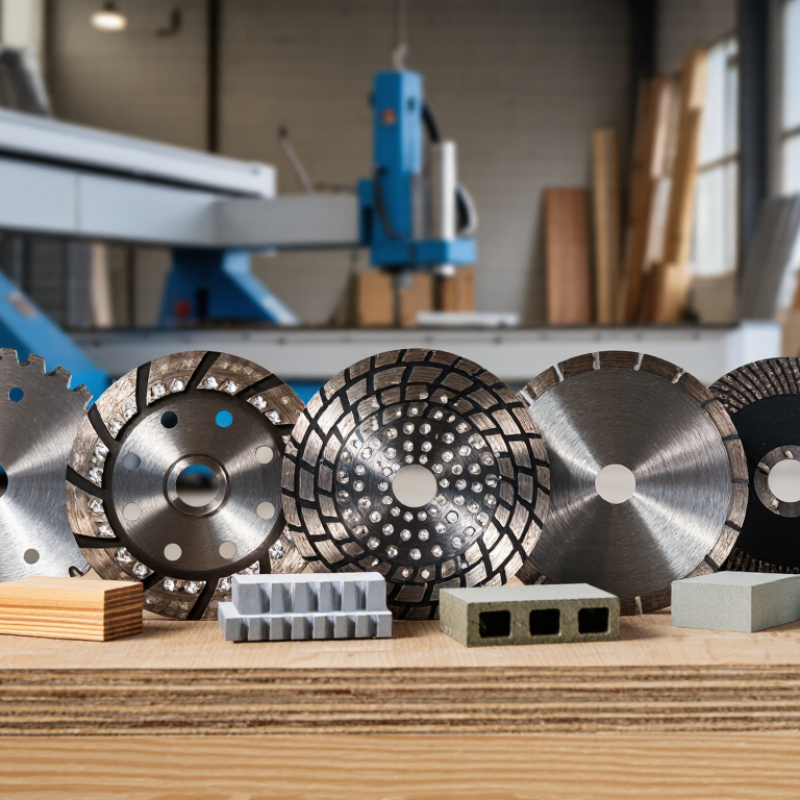
Diamond Blades for Masonry, Concrete, and Stone

In 2026, diamond blades remain a practical choice for cutting masonry, concrete, and stone. Their diamond-embedded edges resist wear better than ordinary abrasive wheels during demanding jobs. The best blade depends on the material, cut quality, and whether speed or a clean edge matters most. There is no single winner.

Segmented blades have gullets between their rim sections. These gaps help clear dust and manage heat, making them useful for fast cuts in concrete blocks, brick, and pavers.

Turbo-rim blades use a ridged edge for a balance of speed and smoother cutting. They can suit dense masonry and some stone, though results vary with the material.

Continuous-rim blades create cleaner edges in tile and delicate stone, but they usually cut more slowly. A rushed choice can chip an expensive slab.

Tips: Match the blade to the material and saw, and check its arbor size and rated speed before use. Follow the blade maker’s wet- or dry-cut instructions; water can control dust when the equipment is designed for wet cutting. Wear eye, hearing, and respiratory protection. Keep the workpiece stable. If the cut wanders, stop and reassess rather than forcing the blade. Even experienced operators sometimes misjudge stone hardness.

Abrasive Blades for Metal and High-Temperature Cutting

In 2026, abrasive circular blades remain practical for cutting steel, stainless steel, and heat-resistant alloys. Aluminum oxide blades suit general carbon steel and produce steady cuts at moderate cost. Zirconia alumina blades remove harder materials faster and often last longer under pressure. For stainless steel, choose a formulation designed to reduce contamination. Silicon carbide blades are better for cast iron, masonry, and other brittle materials. They are usually not the first choice for structural steel.

High-temperature cutting demands control, not force. Excessive pressure can glaze the abrasive surface, raise heat, and discolor the workpiece. A thin blade may cut quickly, but it can flex during heavy work. A thicker blade feels stable, yet removes more material. I still see operators choosing by diameter alone. That is an easy mistake. Check the blade’s rated speed, thickness, arbor size, and material compatibility before installation. Replace any blade with cracks, distortion, or moisture damage.

Tips: Secure the workpiece firmly and keep both hands on the tool. Let the abrasive do the cutting. Short, light passes usually control heat better. Watch for blue marks on steel; they may indicate overheating. Use eye, face, hearing, and respiratory protection suited to the task. Never exceed the marked rotation speed. A small test cut can reveal vibration, poor alignment, or the wrong abrasive type before a larger job begins.

Specialty Blades for Wood, Composites, and Precision Work

What Are the Top Types of Circular Blades in 2026?

Specialty Blades for Wood, Composites, and Precision Work

Woodworking Blades

Woodworking blades vary by cut. Alternate-top-bevel teeth leave cleaner crosscuts, while flat-top grinds clear chips during ripping. For plywood and veneered panels, triple-chip-grind teeth help limit surface tear-out. The USDA Forest Products Laboratory’s 2021 Wood Handbook places wood’s fiber-saturation point near 30% moisture content, though the value varies by species. Moisture matters: wet stock can cut differently and place extra demands on the blade. Tooth count alone is not a reliable selection rule.

Composites and Precision Work

Composites need a different approach. Cement board, fiberglass, and fiber-reinforced panels can wear ordinary carbide teeth quickly. Polycrystalline-diamond-tipped blades often suit abrasive production work, while carbide remains a practical choice for occasional cuts. For delicate laminates, a fine-tooth blade and steady feed can reduce chipping. Precision blades also benefit from a stable plate and suitable kerf width. Thin kerf saves material, but it may deflect more under heavy feed. There is no universal best profile; the workpiece and machine both matter.

Tips: Check the material maker’s cutting guidance, then test on offcuts. Keep the blade clean, confirm it runs true, and never force a cut. Small setup errors show up fast.