Who Are the Top Cutting Tools Suppliers in China?
Choosing a cutting tool supplier is not just a price comparison. In China, buyers can encounter manufacturers specializing in carbide inserts, drills, milling cutters, saw blades, and custom tooling. Their catalogs may look similar. Their production control, technical support, and delivery consistency may not be.
This guide compares suppliers through practical criteria: product range, material expertise, quality systems, customization, export experience, and responsiveness. Machining researcher Milton C. Shaw’s work offers a useful principle, paraphrased here: “Tool performance depends on the relationship between tool material, geometry, and cutting conditions.” That relationship matters on the shop floor. A carbide insert that performs well on stainless steel may not suit a high-speed aluminum operation. Ask suppliers for application data, sample testing, and clear recommendations—not just a polished brochure.
There is no single best supplier for every workshop. A small job shop may value quick custom batches, while a large manufacturer may prioritize stable volumes and documented quality checks. Buyers should verify claims, review relevant certifications, and discuss lead times before placing substantial orders. Details count: edge consistency, coating choices, packaging, and how quickly technical questions receive useful answers. A ranking can still miss something. Supplier performance varies by product line and application, so treat any shortlist as a starting point, not a guarantee.
Understanding China's Cutting Tool Supply Industry
China’s cutting-tool supply industry combines large-scale production with a broad network of specialist manufacturers. The China Machine Tool & Tool Builders’ Association estimated domestic cutting-tool consumption at about RMB 47.7 billion in 2023. That figure signals substantial demand from automotive, aerospace, machinery, and mold-making workshops. It does not mean every supplier offers the same capability. Product mix, coating consistency, delivery stability, and technical support can differ sharply.
Market figures need context. Estimates may use different definitions for tools, imports, and domestic consumption. Buyers should compare suppliers against actual machining conditions, not catalog claims alone. Details matter. Ask for material-specific cutting data, tool-life records, and inspection procedures. A trial cut on the intended machine can reveal vibration, chip-control, and edge-wear issues that samples cannot. Check whether replacement inserts and engineering advice remain available after delivery. A low unit price may be less useful if operators must stop often to reset feeds or change tools. Even this evaluation has limits: one test job may not reflect a full production shift. The most dependable supplier is usually the one that documents performance clearly and responds quickly when results fall short.
Criteria for Identifying Leading Cutting Tool Suppliers
Who Are the Top Cutting Tools Suppliers in China?
Criteria for Identifying Leading Cutting Tool Suppliers
A leading supplier is not defined by catalog size alone. Check whether its tools suit your workpiece material, machine, and production volume. Ask for documented results on tool life, dimensional consistency, and edge wear. Useful evidence includes batch traceability, inspection records, and clear specifications for tool geometry and coating.
Market data gives this evaluation context. Grand View Research’s 2024 Cutting Tools Market Size report estimated the global market at USD 24.6 billion in 2023, with projected annual growth of 6.1% from 2024 to 2030. A growing market can bring more supplier claims, but claims are not proof. ISO 9001 certification indicates a quality-management system; it does not, by itself, confirm machining performance. Compare results under stated cutting speeds, feeds, coolant conditions, and materials. If test conditions are missing, ask for them. Some supplier data sheets leave too much unsaid.
Tips: Request a small production trial using your actual material and machining setup. Record tool life, surface finish, and changeover time. One test may not settle everything, but it exposes gaps early.
Main Types of Cutting Tools Made in China
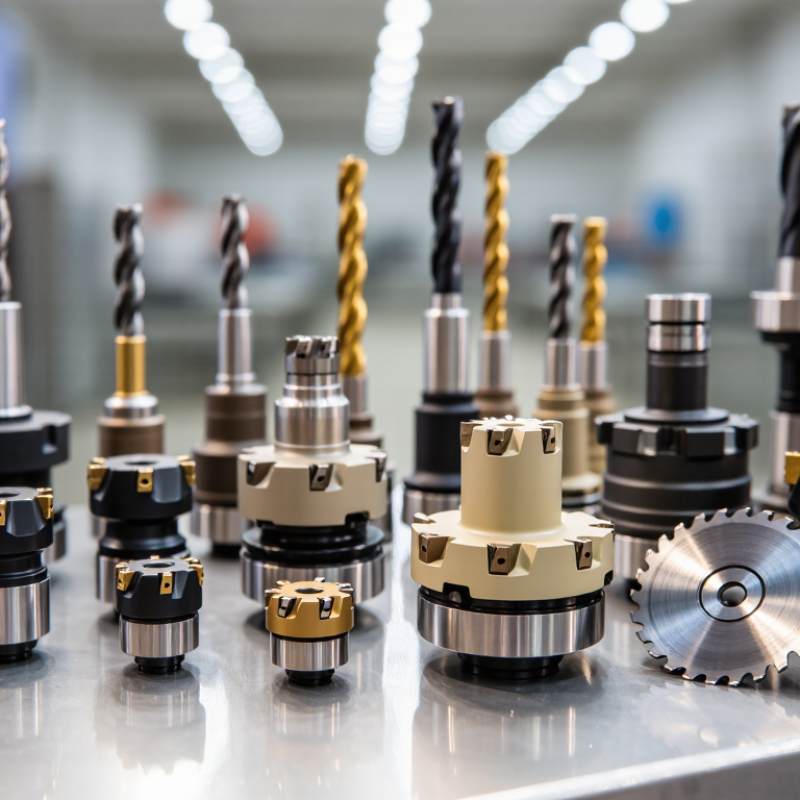
China-made cutting tools cover turning, milling, drilling, threading, and sawing. In metalworking shops, indexable carbide inserts are common for turning and face milling. Operators replace the small cutting edge while keeping the tool holder. Solid-carbide end mills and drills suit precise work, including narrow slots and small holes. High-speed-steel tools remain useful for lower cutting speeds and frequent sharpening. Geometry matters more.
Ceramic, cubic boron nitride, and polycrystalline diamond tools serve more specialized jobs. Ceramics can handle heat-resistant alloys at high speeds; CBN is often chosen for hardened steel. Diamond tools work well with non-ferrous materials, but are generally unsuitable for cutting steel. Not always interchangeable. Tool selection depends on the workpiece, machine rigidity, coolant, and required surface finish—not just the tool material.
Raw materials also shape the supply picture. The USGS Mineral Commodity Summaries 2024 estimated China’s 2023 tungsten mine output at about 63,000 metric tons, out of roughly 78,000 worldwide. Tungsten carbide is widely used in inserts and solid-carbide tools, but this figure does not measure finished-tool quality. ISO 13399 offers a standardized way to describe tool data, helping buyers compare dimensions and specifications. A catalog can make selection look simple; in practice, trial cuts and measured tool life still matter.
How to Compare Suppliers for Different Machining Needs
Comparing Chinese cutting tool suppliers starts with the machining task, not the catalogue price. For aluminum, check chip evacuation and edge sharpness; for stainless steel, ask how geometry and coating manage heat. Titanium needs stable clamping and controlled cutting parameters. Ask for tool drawings, substrate details, coating specifications, and recommended speeds for your exact workpiece. Useful evidence is specific. “Suitable for steel” is not enough.
Run a controlled trial on your own machine. Record tool life, cycle time, surface finish, and edge wear, using the same material batch and cutting conditions. A low quote can still be costly. I would not treat one successful run as proof; small differences in setup can distort results. The USCTI and AMT’s December 2023 Cutting Tool Market Report recorded US consumption of $234.7 million, down 2.1% year over year. This is a demand indicator, not a supplier ranking, but it reinforces the need to compare performance and availability. Also check sample lead time, batch consistency, inspection records, and technical response quality. Ask the supplier to explain a failed test, not just a successful one.
Who Are the Top Cutting Tools Suppliers in China?
How to Compare Suppliers for Different Machining Needs
Suggested buyer-priority weights, not supplier rankings or market-survey results. Adjust them to your workpiece materials, machining process, production volume, and quality requirements. Compare suppliers using documented performance data and sample trials.